
Troubleshooting
Microsoft IIS 10.0 powers millions of websites, but critical vulnerabilities can expose your servers to attacks. These 10 exploits—ranging from remote code execution to authentication bypasses—demonstrate why patching IIS 10.0 is non-negotiable for security-conscious administrators.
HTTP Request Smuggling via Host Header

When your IIS 10.0 server processes HTTP requests, attackers can exploit a sneaky flaw in Host header parsing to smuggle malicious payloads past security controls. This HTTP Request Smuggling technique manipulates how the server interprets request boundaries, allowing attackers to inject hidden commands into legitimate traffic streams.
The vulnerability arises when IIS fails to properly validate or normalize Host header values, leading to inconsistent request parsing between proxies and the backend server. Attackers craft carefully crafted requests that appear valid to one layer but malicious to another, bypassing WAFs and firewalls. Microsoft’s Security Advisory ADV200005 highlights this as a critical risk for servers handling untrusted input.
System administrators running IIS 10.0 on Windows Server 2016/2019 should prioritize patching via the latest Cumulative Updates and enforce strict Host header validation in custom modules. This exploit is particularly dangerous for shared hosting environments where multiple applications share the same server. ⚡
CVE-2021-34473: HTTP/2 Request Smuggling

While traditional HTTP request smuggling relies on flawed header parsing, CVE-2021-34473 takes advantage of HTTP/2 protocol ambiguities—specifically how servers and proxies interpret request boundaries. Unlike HTTP/1.1, HTTP/2 compresses headers and multiplexes requests, creating gaps attackers exploit to smuggle hidden payloads past WAFs and into backend systems.
This vulnerability stems from ambiguous frame boundaries in HTTP/2, where attackers craft malformed DATA frames to manipulate how proxies and origin servers parse requests. A successful exploit can bypass security controls entirely, allowing arbitrary code execution or data exfiltration without triggering alerts. Microsoft patched this in IIS 10.0 cumulative updates (April 2021), but unpatched servers remain at risk.
System administrators running HTTP/2-enabled IIS 10.0—especially those with WAFs or load balancers—should prioritize this fix. Even if your WAF claims to support HTTP/2, CVE-2021-34473 proves no defense is foolproof. 💻
Authentication Bypass via WebDAV

When NTFS permissions are in place but WebDAV is misconfigured, attackers can slip past authentication entirely—thanks to a sneaky flaw in how IIS 10.0 handles directory access. This exploit doesn’t just bypass logins; it lets unauthorized users traverse restricted folders as if they had full rights.
The vulnerability stems from WebDAV’s PROPFIND and MKCOL methods, which can be manipulated to bypass IIS’s native security filters. Even with IIS_IUSRS or Authenticated Users permissions denied, an attacker could still access sensitive directories by crafting requests that exploit path normalization failures. Microsoft’s own documentation warns that WebDAV should only be enabled when absolutely necessary.
System administrators managing legacy applications or shared file repositories should disable WebDAV entirely unless required, or restrict it to specific IP ranges. This exploit is particularly dangerous in environments where shared hosting or multi-tenant setups rely on IIS 10.0. 💻
CVE-2020-1375: IIS Short Name Denial of Service

If your IIS 10.0 server suddenly crashes with a Blue Screen of Death (BSOD) or becomes unresponsive, CVE-2020-1375 might be the culprit. This vulnerability exploits Windows' legacy 8.3 filename parsing—a relic from DOS-era file systems—to trigger kernel-mode memory corruption, causing system instability or even remote code execution.
The flaw lies in how IIS processes short filenames (e.g., FILE~1.DOC instead of FILENAME.DOC). Attackers send specially crafted requests to force the server into an infinite loop or memory exhaustion, crashing the system. Microsoft patched this in April 2020 via KB4551762, but unpatched servers remain at risk.
This exploit is particularly dangerous for enterprise environments hosting legacy applications relying on 8.3 filenames, as it requires no authentication and can be triggered remotely. ⚡
Memory Corruption via Malformed Content-Length

When attackers manipulate the Content-Length header, they can trigger heap overflows that corrupt memory and escalate privileges to SYSTEM level. Unlike other exploits that rely on protocol ambiguities or misconfigurations, this vulnerability directly targets IIS’s memory management when processing oversized or malformed headers.
The attack works by sending a Content-Length value that exceeds the actual payload size, causing IIS to allocate insufficient memory buffers. This forces the server to process data outside allocated heap space, enabling attackers to overwrite critical structures and execute arbitrary code. Microsoft’s patches for this typically involve stricter input validation and bounds checking in the HTTP.sys driver.
System administrators running legacy IIS 10.0 deployments—especially those handling high-traffic APIs or file uploads—should prioritize this patch. The risk isn’t just theoretical: public exploit proofs have demonstrated remote code execution in default configurations. 💻
CVE-2019-0787: IIS Chunked Encoding Buffer Overflow

When attackers exploit chunked transfer encoding, they can turn IIS 10.0 into a playground for remote code execution—all because of a single parsing flaw in how the server handles data chunks. Unlike other vulnerabilities that rely on malformed headers or WebDAV misconfigurations, this exploit weaponizes a core HTTP feature, making it harder to detect with traditional security tools.
The CVE-2019-0787 vulnerability occurs when IIS fails to validate chunked encoding boundaries, allowing attackers to craft oversized or malformed chunks that overwrite adjacent memory. This leads to arbitrary code execution in high-privilege contexts, such as SYSTEM-level access, without requiring authentication. Microsoft patched this in April 2019 via security updates, but unpatched servers remain at risk.
This exploit is particularly dangerous for enterprise environments where IIS hosts critical applications, as it bypasses many security controls designed to block low-level memory corruption. If you’re managing IIS 10.0, prioritize applying the latest cumulative updates and disable chunked encoding if it’s not strictly necessary. 💻
Directory Traversal via URL Encoding

When your IIS 10.0 server enforces strict URL rewriting rules, attackers can still slip past defenses using double-encoded slashes (%255c) to traverse directories outside the web root. This sneaky technique bypasses path validation entirely, exposing sensitive files like configuration backups or system logs.
The exploit works by encoding slashes twice—once as %25 (URL-encoded percent sign) and again as %5c (URL-encoded backslash)—tricking IIS into interpreting the path as legitimate. Even with IIS URL Rewrite Module rules in place, this method often slips through unnoticed, granting attackers access to restricted directories like C:\Windows\ or C:\inetpub\.
System administrators managing legacy applications or shared hosting environments should audit URL rewriting rules and restrict directory listings to mitigate this risk. ⚡
CVE-2017-7269: IIS WebDAV ScStoragePathFromUrl Buffer Overflow
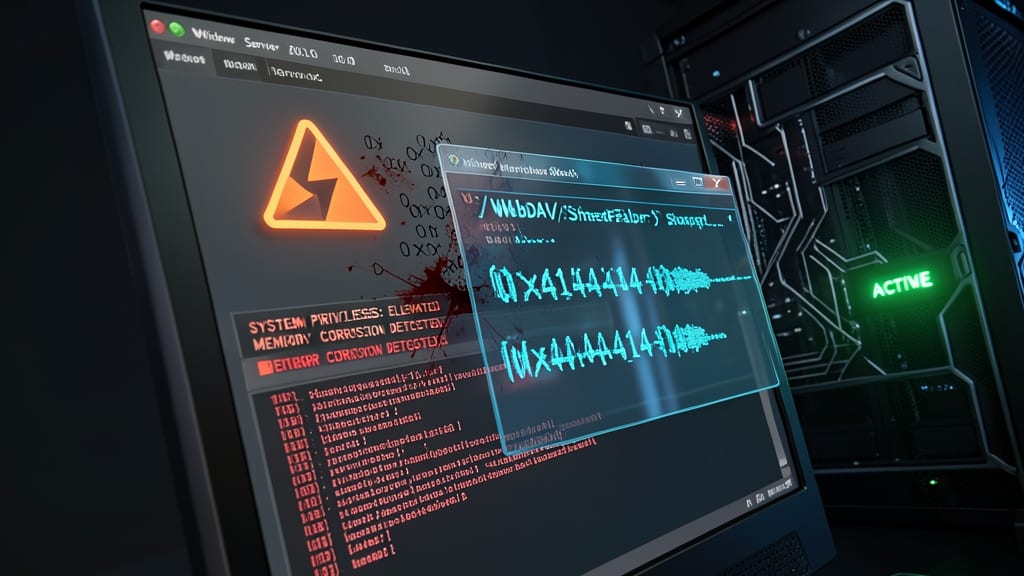
If your IIS 10.0 server relies on WebDAV for file sharing, CVE-2017-7269 could turn a simple file request into a full-blown security breach. This buffer overflow vulnerability exploits a flaw in how IIS parses WebDAV paths, corrupting memory to execute arbitrary code with SYSTEM-level privileges. Unlike other exploits that target headers or encoding, this one weaponizes the ScStoragePathFromUrl function itself.
The attack chain starts with a maliciously crafted WebDAV request designed to overflow the path parsing buffer. Once memory corruption occurs, attackers can escalate privileges or execute payloads without authentication. Microsoft patched this in July 2017 (KB4025342), but legacy systems or misconfigured WebDAV setups remain at risk. The exploit’s precision—targeting path parsing logic—makes it particularly stealthy.
This vulnerability is a must-patch for organizations using WebDAV in IIS 10.0, especially those with shared hosting environments where attackers could exploit it to compromise multiple tenants. 💻
Server-Side Request Forgery via HTTP Redirects

What if an attacker could trick your IIS server into making requests to internal systems—like your database or admin panels—without your knowledge? Server-Side Request Forgery (SSRF) via HTTP redirects does exactly that by exploiting IIS’s handling of 3xx status codes, forcing it to follow unauthorized links to internal endpoints.
This attack works by sending a malicious request with a Location header pointing to an internal IP or service (e.g., http://192.168.1.100/admin). If IIS lacks proper redirect validation, it will blindly follow the path, exposing sensitive data or even allowing attackers to pivot deeper into your network. Unlike client-side SSRF, this bypasses traditional perimeter defenses since the request originates from your server itself.
System administrators managing internal-facing IIS servers or those with exposed admin interfaces should prioritize this risk. Disabling unnecessary HTTP redirects and implementing strict IP whitelisting can block these attacks before they escalate. 💻
CVE-2015-1635: IIS Kernel-Mode Elevation of Privilege

If your IIS server runs on Windows Server 2012 R2 or earlier, you’re at risk from CVE-2015-1635, a kernel-level exploit that bypasses even the most robust user-space defenses. Unlike other IIS flaws targeting application layers, this one strikes at the core—HTTP.sys, the kernel-mode driver handling all HTTP requests.
The vulnerability lets attackers escalate privileges to SYSTEM level by sending a crafted HTTP request that triggers a race condition in HTTP.sys. Microsoft patched it in MS15-034 (April 2015), but unpatched systems remain exposed to silent, stealthy privilege escalation—ideal for attackers already on your network. Unlike buffer overflows or DoS flaws, this exploit doesn’t crash your server; it infiltrates silently.
System administrators managing legacy IIS deployments or those with restricted patching cycles should prioritize this fix. Even modern systems with hardened configurations aren’t immune if they host vulnerable versions of HTTP.sys. 💻